
Brady UX
my product · a course · 2026out loud

You have an idea,
let's hear it.

out loud is a self-paced course that takes someone from "I have an idea" to a real app on the internet, with no code. The twist: the learner's idea is the curriculum. Every lesson rebuilds itself around the thing they're actually making.

Role
Course design, curriculum, product
Format
Self-paced web app, six modules
Status
Live at outloud.bradyux.com
visit outloud.bradyux.com ↗
6modules, from a spoken idea to a live URL
0lines of code the learner has to write
24poses for the guide who teaches it
~120builder words in the plain-language phrasebook
The idea

The learner's idea is the curriculum

Almost every build-it-yourself course teaches with the instructor's demo project. You finish knowing how to build their to-do app, not your thing. out loud flips that. The first thing you do is tell the course your idea, out loud, and from that moment every lesson, every example and every prompt it hands you is written for your project.

In practice that means the course interviews you, turns your rambling answers into a project brief, and carries that brief into everything after. The amber parts of every lesson are the tailored parts: they change for each learner.
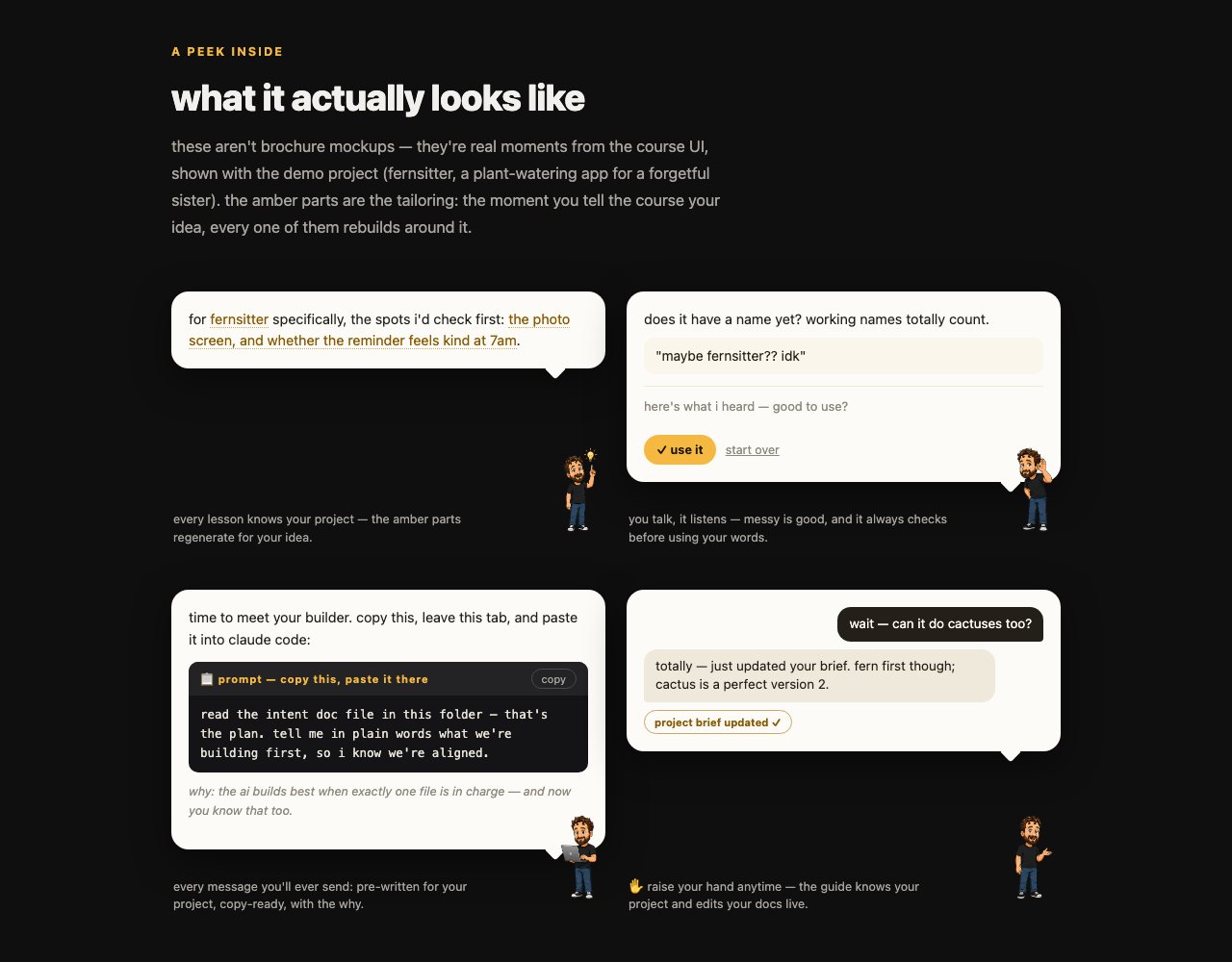

Real moments from the course, shown with the demo project, a plant-watering app for a forgetful sister. Amber text is tailored to the learner's idea.
The shape

Six modules, one idea the whole way

The course follows the same loop I use on real work: describe it, get interviewed, write the plan, build in small steps, make it good, ship it. Each module ends with something real for the learner's own project: a brief, a discovery doc, an intent doc with a clear cut-line, a working build, a quality checklist, and finally a live link.

Module two is where the method shows. The course drafts the plan, then argues with them about scope. Most of what they want goes on a "later" list, so nothing is lost, and what survives is small enough to actually finish.

  1. Day 1tell it your idea: the interview and the brief
  2. Week 1talk first: the discovery doc
  3. Week 2the plan: an intent doc and an MVP cut-line
  4. Weeks 3–4build it, one prompt at a time
  5. Week 5make it good: the quality pass
  6. Week 6ship it: a live URL and a version-two list
The suggested pace. It's self-paced, and the app nudges but never shames.
The design

Talking, not typing. A guide, not a video wall.

The core skill the course teaches is describing what you want until it's built, so the course itself runs on talking. You answer questions by speaking; messy is fine. There are no forms and no text editors. If you want to change your brief, ask a question or say "wait, go back", you raise your hand and tell the guide, and he updates your documents in place.

The guide is a cartoon version of me with 24 poses: listening, explaining, building, celebrating. It's built to be easy on the brain too: one thing at a time, short lessons, plain language, a tap-a-word phrasebook for every builder term, and accessibility treated as part of the craft rather than a checklist.

ListeningListening
ExplainingExplaining
BuildingBuilding
ShippingShipping
Four of the guide's 24 poses. Each one maps to a moment in the course.
The testing

Run it blind, then fix what real people hit

Before anyone paid, I ran the whole course blind: a made-up soccer parent with an idea for a team snack schedule, following only what was on screen. The question was simple. If you only do what the course tells you, do you end up with a real thing on the internet? The answer was yes, and the snack app went live. The run also found bugs, and every one was fixed the same day.

Then real testers came in, and they found what I couldn't. One person's microphone never captured a word, and the failure was invisible. Another lost his first session's answers to a sync bug. One beta tester, who sells software for a living and doesn't write code, had his own app running on his phone three weeks after he started.

1
Never lose someone's workan error never wipes progress; the newer copy always wins
2
Show that it's listeninga level meter and an honest message when the mic fails
3
Never say "there it is" over an errora failed document retries instead of pretending
4
Ask, don't guess silentlywhen the course has to guess, it marks the guess and asks
Rules the course now follows, each one learned from a real run.
Looking back

The app is the homework. The skill is the prize.

A course like this can't prove itself with the author's own projects. It only works if someone else, with their own idea, walks out with something real. That's the bar every change gets measured against.

It's priced to grow with the proof: $149 for the first twenty founding seats, then $299, and the price only goes up.